USS West Virginia (BB‑48) · 7 December 1941
Doris
Miller
Mess Attendant Second Class, U.S. Navy · Waco, Texas
He carried wounded men through burning oil, helped move his dying captain off the bridge, and manned an anti‑aircraft gun he had never been trained to fire. Almost everything else you will read about that morning is in no document at all.
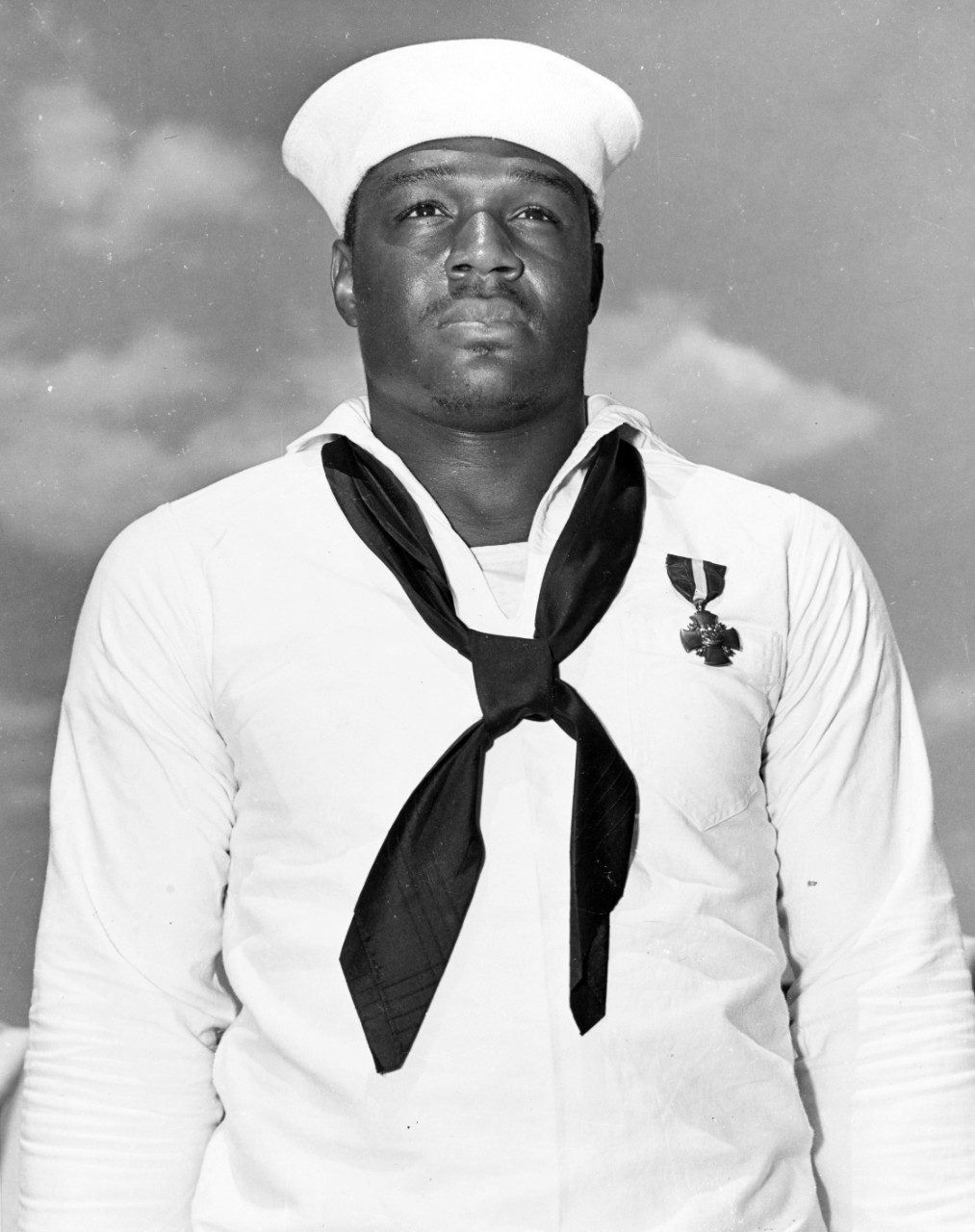
What the record says
One sentence, typed four days later
The USS West Virginia action report was signed on 11 December 1941 by Lieutenant Commander R. H. Hillenkoetter, the ship’s senior surviving officer. Eight officers’ statements were attached to it. Two of them name Miller — and one of those two was written by the officer standing at the next gun.
Enclosure (H) — Statement of Lieut. (jg) F. H. White
“Under direction of Lt. Ricketts, material to construct a stretcher on which to lower the Captain was procured, while D. Miller, Matt.2c. and I manned #1 and #2 machine gun forward of the conning tower.”
That is the machine gun. A primary document, written four days after the attack by the officer beside him. It is also the limit of what the record establishes: it says he manned a gun. It records no result.
Contested claim
How many aircraft did he shoot down?
The Navy credited him with none. Neither the Secretary of the Navy’s commendation nor the Navy Cross citation claims a single aircraft destroyed, and no officer’s statement does either. Miller himself gave different numbers at different times. Popular accounts say two, four, five or six; a Texas legislative resolution says four. None of those figures can be traced to a contemporaneous document.
The machine gun: what the record says →The life
Twenty-four years, four of them in uniform
Doris Miller was born on 12 October 1919 near Waco, McLennan County, Texas, the third of four sons of Connery and Henrietta Miller, sharecroppers. He enlisted at Dallas on 16 September 1939 and was assigned, as Black sailors then were, to the Steward’s Branch — the only branch of the Navy open to them. He joined USS West Virginia on 2 January 1940 and was still aboard her two years later.
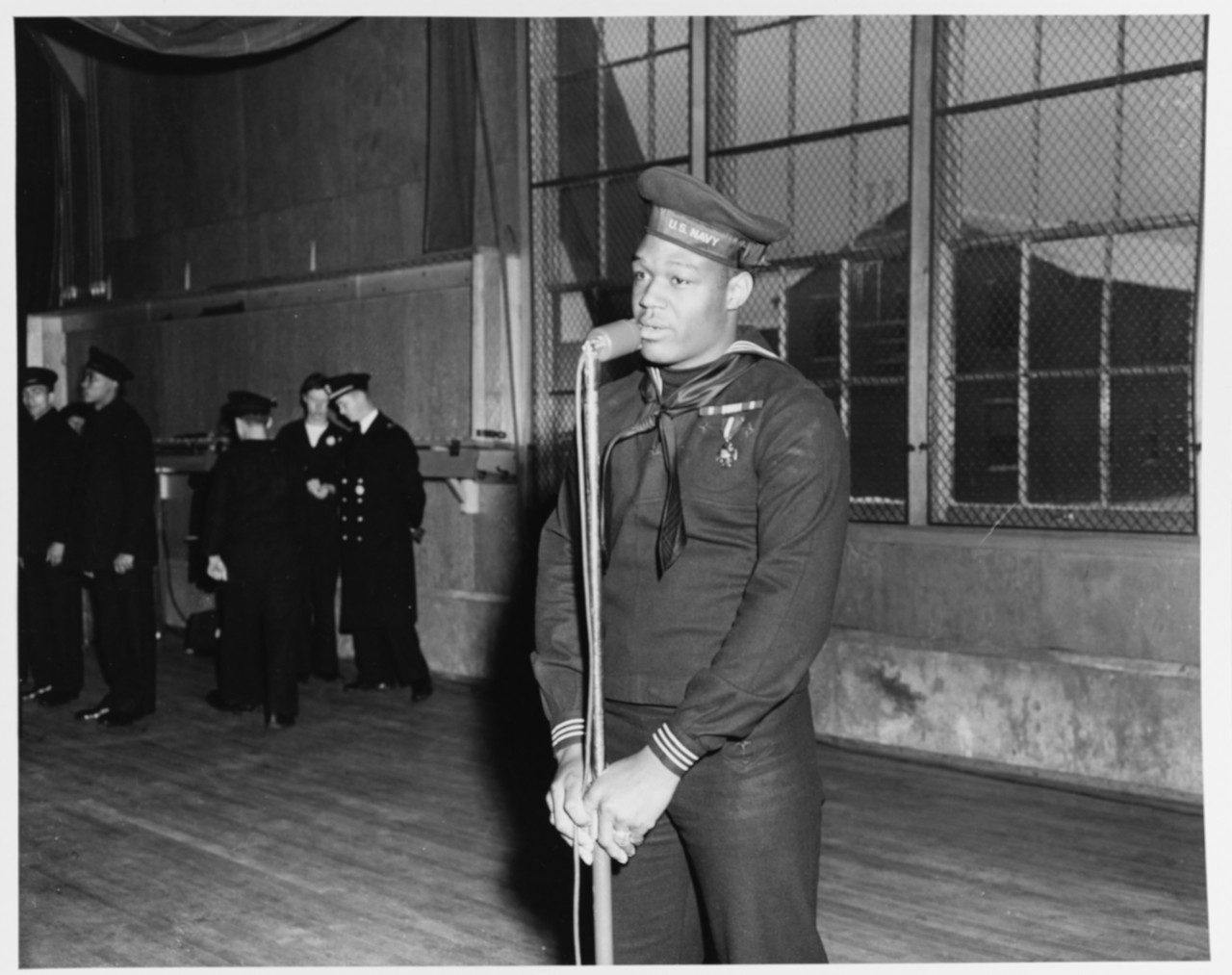
He left the ship on 13 December 1941, six days after the attack, for the heavy cruiser USS Indianapolis, where he served about seventeen months. In between came a war bond and recruiting tour, and advancement through the mess attendant ratings to Ship’s Cook Third Class. In 1943 he joined the escort carrier USS Liscome Bay. She was torpedoed off Butaritari on 24 November 1943 and sank in roughly twenty-three minutes. Miller was not among the survivors, and was officially presumed dead a year and a day later.
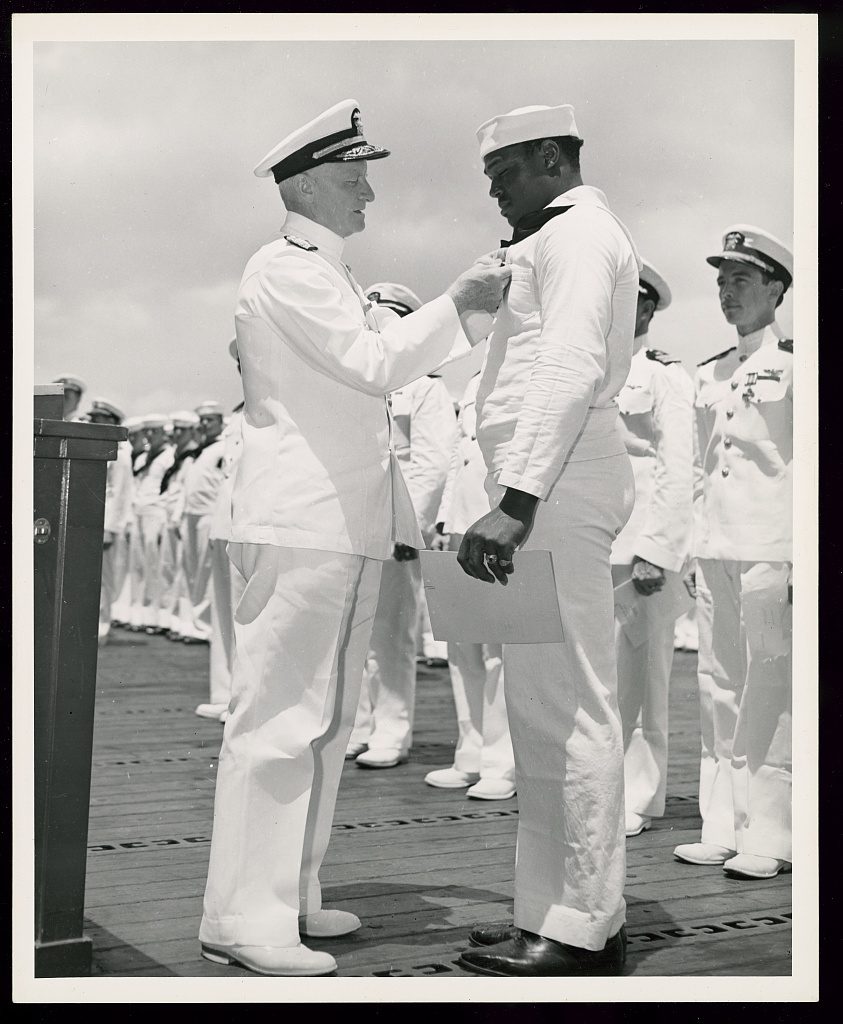
The Navy Cross was, in May 1942, the service’s third-ranking decoration — the Act of 4 February 1919 placed it below both the Medal of Honor and the Distinguished Service Medal. The Act of 7 August 1942 re-ordered them, moving the Navy Cross above the DSM ten weeks after Miller received his. Bills to award him the Medal of Honor have been introduced repeatedly since; none has passed. The full award history →
Why the record matters
The legend was built while the file was still closed
The Navy did not publicly identify Miller until March 1942 — the Pittsburgh Courier got his name and printed it that month, three months after the attack. In the interval the press filled the silence. A story in the New York Times of 22 December 1941 quoted an unnamed naval officer describing a Black sailor who had “never before fired a gun” and manned a machine gun until his ammunition ran out. That sentence, not a document, is the origin of the line about a man who had never touched a gun.
What followed it accumulated. In 1975 Ronald Reagan — then a private citizen, six years before he became president — told an audience Miller had shot down four dive bombers, and that segregation in the armed forces ended at Pearl Harbor. Neither is true: the Navy credited him with no aircraft, and military segregation ended with Executive Order 9981 in 1948. A 2001 feature film added a body count of its own.
Each of those is checkable against a document, and each of them fails. That is the whole reason this site exists: not to diminish what Miller did, but to stop it being defended with claims that cannot survive an afternoon in an archive.
Start anywhere
The site
Waco, the Steward’s Branch, Pearl Harbor, Indianapolis, the bond tour, Liscome Bay. The whole life, not just the morning.
Hour by hour aboard West Virginia, reconstructed from the action report and the eight officers’ statements attached to it.
Which gun, for how long, who saw it, and what the witnesses explicitly did not see.
The Pittsburgh Courier campaign, the decoration decision, and every Medal of Honor bill introduced since.
West Virginia, Indianapolis, Liscome Bay, USS Miller (FF-1091), and the future carrier CVN-81.
Dated entries from 1919 to the present, each tied to a source.
Waco, the VA medical center, the schools, the stamp — and what is not at Pearl Harbor.
Claims that circulate widely, checked one by one against the documents.